

The audience is scrolling at the speed of thought. Is your content capable of stopping their thumbs or it gets lost in the noise?
Every brand today is fighting the same battle: attention. It’s the most valuable currency in the digital world, and it’s in short supply. With endless content flooding every feed, inbox, and screen, only the most compelling stories survive.
While well-crafted text can inform, persuade, and even inspire; video has a unique power. It shows, feels, and connects in real time. In just few seconds, videos can spark emotion, build trust, and drive action. This is the reason why the video vs text debate keeps growing.
As content habits change, one thing becomes clear. Video captures and holds attention in ways static formats often fail to match. The format you choose directly impacts how your audience feels, reacts, and remembers.
So, where do you stand in this conversation? Are you communicating in the way your audience wants to receive information?
Table of Contents
Why Video Content Often Wins the Attention War?
Drive More Engagement
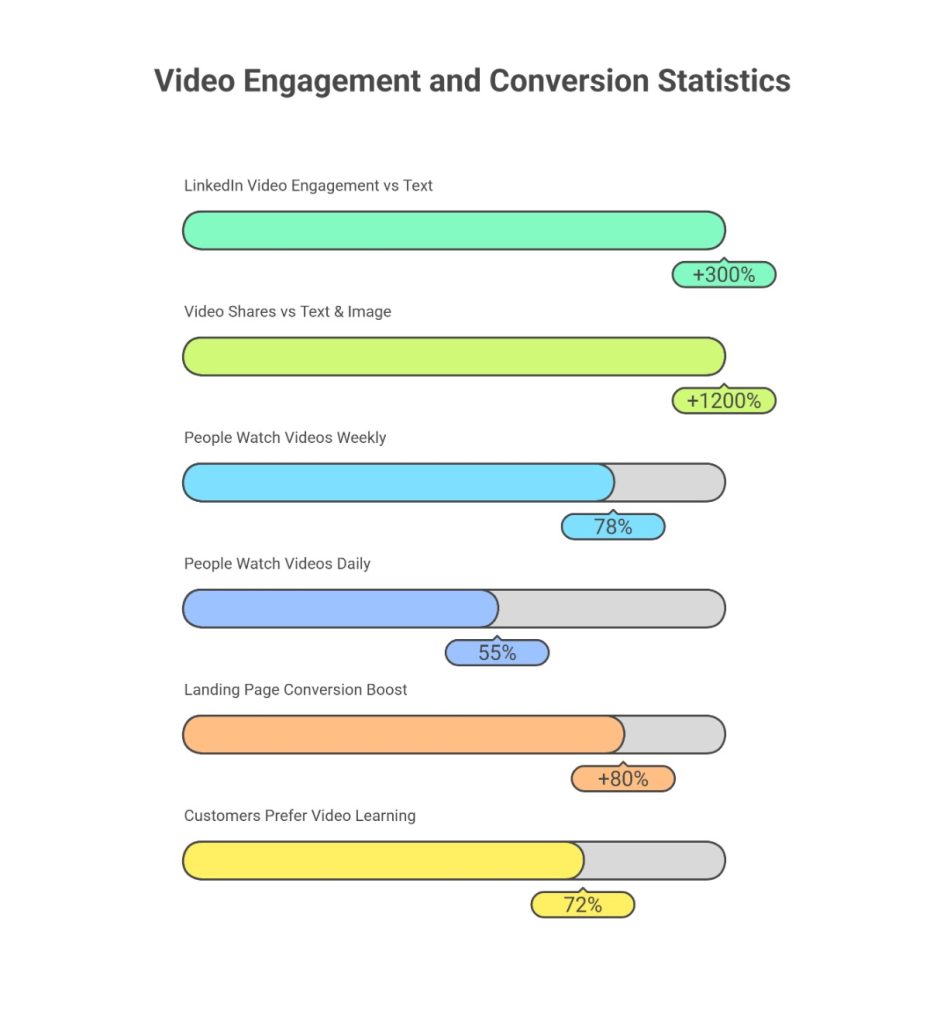
- Video posts on LinkedIn get 3x more engagement than text-only posts. (Source: Insivia Video Marketing Stats 2025)
- Social media videos generate 1200% more shares than text and image content combined. Videos get more shares, more views, and higher engagement, giving your brand an opportunity to expand reach beyond existing audiences. (Source: Insivia Video Marketing Stats 2025)
- 78% of people watch videos weekly and 55% daily. (Source: Insivia Video Marketing Stats 2025)
- Videos on brand landing pages can increase conversion rates significantly. One source notes that a video on a landing page can boost conversions by as much as 80%. (Source: Invideo)
- Many consumers prefer to learn about a product or service through video. A recent survey found that roughly 72% of customers would rather learn via video. (Source: Valueleaf)
The above data shows that video is a powerful way to capture attention, especially in a noisy online landscape. Video feels natural to consume as people understand information faster when they watch instead of reading. This increases engagement and encourages more interaction.
Video Content Boosts Memory, Understanding, and Emotional Impact
Humans remember visuals more than text. Many studies support this pattern.
- Viewers retain 95% of a message when watched in a video compared to only 10% when reading it as text. (Source: Motionbox)
- Video combines visual + auditory cues + motion, enhancing comprehension and emotional impact. This multimedia approach helps people process information faster and more deeply than text alone. (Source: LV productions)
Because of the above reasons, video works well when you want to explain complex ideas, demonstrate how things work, or evoke emotion.
For example, consider a brand launching their new software tool. A well-produced demo video showing the tool in action helps viewers grasp what the tool does, how it works, and why it matters instantly. Trying to achieve the same clarity through text alone would require long explanations, which many readers might abandon or skim.
This is why brands should use product demos, explainer videos, and story-driven videos. Because they turn difficult ideas into experiences that people remember.
Videos Convert Better
Video influences buying decisions. Marketers see strong results when they add video to landing pages and product listings.
- 90% of marketers report a positive ROI from videos.
- 87% of businesses say that video has directly increased their sales.
- Product pages with video see 47% higher engagement.
(Source: Insivia Video Marketing Stats 2025 & TwinStrata)
With the above data, we can conclude that the marketers leveraging video often see faster revenue growth, higher engagement rates, and more qualified leads. A single video can change how a visitor understands value and that clarity leads to higher conversions.
Mobile Behaviour: Video Wins on Mobile
With smartphones dominating how people consume content, video naturally fits mobile consumption. A large share of video consumption happens on mobile devices.
- 70% of YouTube watch time comes from mobile.
- 85% of mobile videos are watched without sound. Captions matter to improve results.
(Source: Insivia Video Marketing Stats 2025)
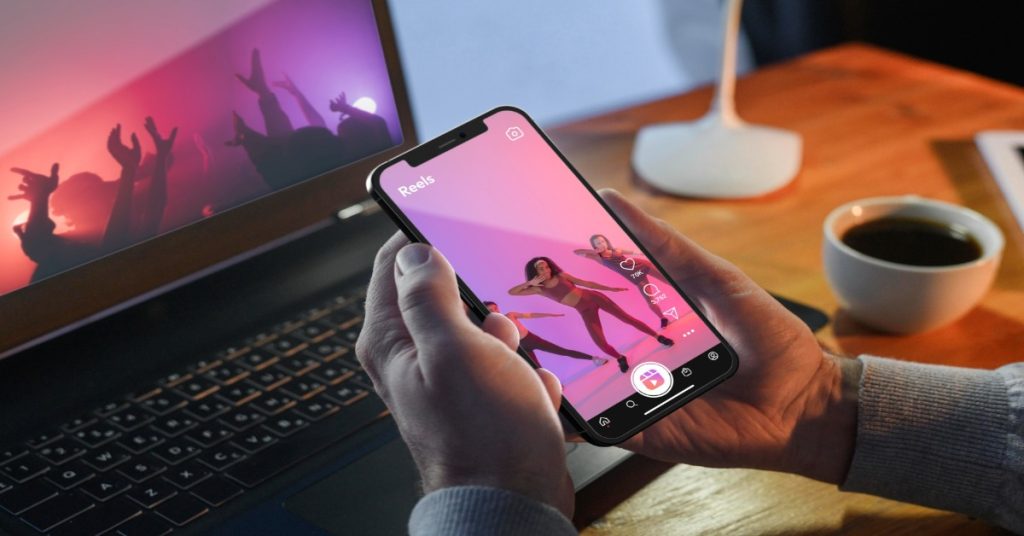
Short, vertical and captioned videos dominate the mobile feeds. People use phones for learning, entertainment, shopping, and research. And videos complement this behavior perfectly.
Text Still Has Its Own Place: Don’t Count It Out Yet
Just because video is powerful does not mean text is obsolete. In many scenarios, text remains indispensable:
- Text is crucial for SEO and discoverability. Blog posts, articles, and long-form content help search engines understand themes, keywords, and context. They drive organic traffic over time. Text is better for SEO, long-form education, and evergreen content.
- Text is often preferred for in-depth learning. When readers want to learn deeply about a topic, it can be presented in the form of a detailed whitepaper, guide, or how-to blog. All these text pieces provide the structure and detail they need.
- Text caters to audiences who prefer reading or those who need to quickly scan or reference information. Technical documentation, FAQs, or product specs often perform better as text.
- For accessibility and quick load times (especially in low-bandwidth regions), text remains more reliable than video.
Text also complements video. Transcripts, captions, summaries, and blog posts help search engines index content while giving readers a second content format to learn from. So, we can safely say that text is not going anywhere.
The Wise Path: Combine Video and Text Content for Maximum Impact
The most effective content strategies don’t see video and text as competitors. Instead, they use both and play with their strengths.
- Use video when you want to capture attention, create emotion, show products or processes in action, or increase conversions.
- And text for depth, detail, context, SEO value, and easy indexing.
- Use video + text together like embed a video in a blog post, provide a transcript or summary below, and optimize keywords for search. This way, you get the best of both worlds: engagement, retention, SEO, and accessibility.
Many modern brands follow this hybrid strategy. They publish blog posts that include explainer videos, customer testimonials, or product demos. This helps them reach both casual browsers (who may play the video) and detail-oriented readers (who prefer reading).
Examples of Video + Text Content Success
1. CaseComplete: 23% More Conversions
The company CaseComplete saw a 23% increase in conversions when they used a 90-second-long explainer video on their landing page. (Source: unbounce)
2. RankWatch: 27% More Signups
After RankWatch added a 98-second animated explainer video on their homepage (replacing their previous banner), they saw a 27% hike in free-trial signups and their bounce-rate dropped from 62% to 35%. This shows how a clear and well-placed video can improve clarity, engagement and conversion even for a complex SaaS product. (Source: crackitt)
3. Crazy Egg: 64% Lift in Conversions
Crazy Egg embedded an animated explainer video on their page. They gained a 64 percent increase in conversions and added more than 21,000 dollars in monthly revenue. This case underscores the ROI potential of video content when used correctly; not just for engagement, but for direct financial return. (Source: demoduck & comparecamp)
These case studies show how video strengthens clarity, trust, and decision making. These mixed-format strategies make content more accessible, shareable, and effective across varied audience preferences.
The Final Verdict
Video Content Wins the Attention War but Text Complements It
The most successful brands understand how to pair the strengths of each medium to amplify their message. It’s about understanding the psychology of your audience, the platform you’re on, and the goals you’re driving towards.
In the end, this isn’t a battle of better vs. worse, it’s all about strategy. The real advantage comes when brands use both formats with intention.
- Use video for impact, to create emotion & improve engagement.
- Use text to build authority, provide depth and to increase SEO.
- The best strategy? Combine both formats for maximum reach and better user experience.

Video wins when you need impact, emotion, speed, and engagement. It excels at delivering messages that stick, converting viewers into customers, and telling stories that resonate in seconds.
Text remains essential for detail, discoverability, longevity, and depth. It caters to readers who want substance over spectacle, information over emotion. It explains complex topics and supports every stage of research.
This blend helps brands communicate clearly, earn trust, and stay visible in the attention economy.
Frequently Asked Questions (FAQs) related to Content Format
Q1- What type of content is most engaging?
Short-form videos are currently the most engaging type of content across social media and digital platforms. They capture attention quickly, evoke emotion, and are easy to consume. However, long-form text content remains engaging for audiences seeking depth, detail, and in-depth learning.
Q2- What content do most people watch?
Most people watch short and mobile-friendly videos like reels, explainers, tutorials, and product demos. These formats perform especially well on platforms like YouTube, Instagram and LinkedIn because they are easy to digest and visually engaging.
Read More
Understanding the Importance of Corporate Video Editing for Brands

Mobile Video Editing Apps That Every Content Creator Should Know

Why Storyboarding & Script Writing Are the Foundation of a Successful Corporate Video?
Q3- Which is more appealing, text or video?
Video tends to be more appealing for quick consumption, emotional storytelling, product demonstrations, and brand communication. Text becomes more appealing when users want detailed information, research-focused content, or content they can skim and reference at their own pace.
Q4- Do videos get more engagement?
Yes, videos consistently receive higher engagement than text-only content. They generate more likes, comments, shares, and watch time across platforms. Statistics show video posts can get up to 3x more engagement on platforms like LinkedIn and 1200% more shares than text and images combined.
Q5- Why are videos better than text?
Videos combine visuals, sound, and motion, making information easier to understand and remember. They trigger emotions, show real-time context, simplify complex ideas, and influence buying decisions more effectively. This makes video especially strong for brand storytelling, product demos, and conversions.
Q6- Are videos more effective than reading?
In many cases, yes. Viewers retain up to 95% of a message through video compared to around 10% through text. Videos also increase conversions, improve engagement, and make complex information easier to comprehend. Still, reading is more effective for in-depth learning, SEO, and detailed research.